Our Blog: December 16, 2025
- 877.684.1613
- Schedule a Tour

On any given day, my four-year-old is learning many things. On the drive home from school, she teaches me how to zip a zipper, how to write the uppercase letter U, the names of the four seasons, things that begin with the sound ‘m,’ the way two triangles form a rectangle, colors that combine to make purple, and that she doesn’t care for onions even though her friend does.
I am happy to hear she is learning so much! Yet, I wonder, what should she be learning at school? What will help her to be ready for kindergarten and beyond? The answer in early childhood education research is clear: Children should be learning unconstrained skills.
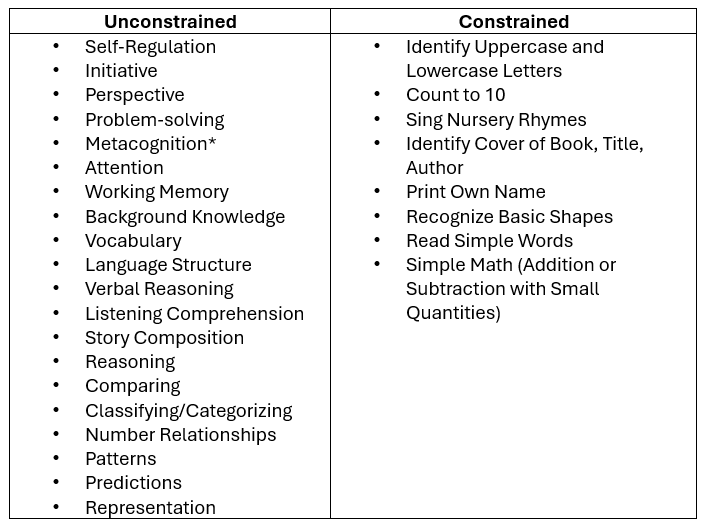
Unconstrained skills are also known as “overarching concepts and complex skills.” They have significance throughout our lives and are important across multiple contexts. They do not have a limited scale with a ‘perfect score’ to demonstrate mastery; instead, they become increasingly complex and important for learning well beyond early childhood. They are also difficult to teach and assess, and therefore, are not measured through traditional school readiness assessments.
Here are some examples of unconstrained skills compared to constrained abilities:
Lifelong Significance
Unconstrained skills are critical from ages 3, 13, 30, and beyond. For example, initiative is an unconstrained skill with continued significance throughout our lives. At 3, a child may be learning ways to initiate going to the bathroom, joining other kids at play, asking for help, getting dressed independently, and narrating picture books. At 13, that same child continues learning ways to take initiative, including breaking down a large assignment into manageable chunks, sharing, and defending a theory about mathematical data, and making a play on the soccer field. At 30, the child is now an adult still navigating and learning effective strategies for initiating new friendships, financial investments, and professional goals. Regardless of our age, we rely on a wide range of unconstrained skills.
Important Across Multiple Contexts
Unconstrained skills are useful and essential across many contexts. Often, these are referred to as cross-curricular concepts or skills from multiple domains. Let’s think about the ability to make predictions. In school, we make predictions within scientific inquiry, mathematical estimates, literary foreshadowing, and historical patterns. We also make predictions when we use fine motor skills to pour drinks without spilling, gross motor skills to throw a basketball into the net, social-emotional skills to understand why a friend is sad, and adaptive skills to choose appropriate clothing for the weather. Making sense of the link between what is and what will be is a complex skill. Unconstrained skills are essential in learning and in daily life.
Cannot Be Mastered
Unconstrained skills are expansive and complex, wide, and deep. There is no ceiling or perfect score assigned for the mastery of unconstrained skills. Instead, they continue to become more complex over time. Language structure is an unconstrained skill that infants begin exploring at birth and that adults continue to navigate for a lifetime. For example, even the best public speakers and professional writers never master everything there is to know about language structure. There is always another language to learn nuances and different structures. There are always new words and phrases being created within a field’s lexicon or profession’s jargon. And there are always inventive ways to manipulate established language structure to make a poetic point or a lyrical line.
Difficult to Teach and Assess
Because of their abstract application, unconstrained skills are not included in typical school readiness assessments. They are not specific to one domain or subject area, so no single content area claims to teach, assess, or measure them. Unconstrained skills cannot be mastered, so assessment tools do not show mastery or completion. For example, *metacognition is an unconstrained skill known as thinking about your thinking. But how do we assess this? And when do we proclaim someone to be an expert in metacognition? The answer is simple: We can’t! Teaching children to be aware of and process their own thinking and reasoning is a challenge faced by every teacher, parent, mentor, and caretaker. Whether kids are 5 or 15, we are teaching them to think about their thinking while reading a book, solving a problem, weighing the consequences of an action, or responding to peers. Unconstrained skills are critical but challenging to teach and assess.
Stay tuned for Part 2 of our in-depth look at this topic and learn how unconstrained skills show up in early learning environments. We’ll explore how unconstrained skills matter for long-term learning outcomes and how parents can intentionally support their development.
About the Author
Kateri Thunder, Ph.D.

A member of our Education Advisory Board, Dr. Kateri Thunder’s experience includes serving as an inclusive early childhood educator, an Upward Bound educator, an assistant professor of mathematics education at James Madison University, and Site Director for the Central Virginia Writing Project. She is also the best-selling author of the book, Visible Learning in Early Childhood and the Teaching Mathematics in the Visible Learning Classroom series. Dr. Thunder’s work focuses on equity and access in early childhood.